30-Second Ancient Rome: The 50 Most Important Achievments of a Timeless Civilisation, Each Explained in Half a Minute by Dr. Matthew Nichols
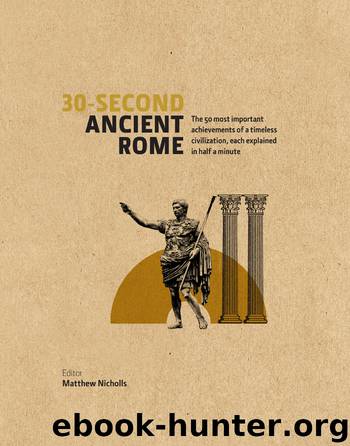
Author:Dr. Matthew Nichols [Nichols, Matthew]
Language: eng
Format: epub, azw3
Tags: History, Ancient Civilizations, Rome, Europe
Amazon: B00VV28UP8
Publisher: Ivy Press
Published: 2014-08-01T22:00:00+00:00
30-SECOND TEXT
Dunstan Lowe
Sculptures represent speechmakers with upraised palm or pointing finger, and always in the toga of the dignified stateman.
VIRGIL
Publius Vergilius Maro (known in English as Virgil or Vergil) lived during the period of the civil wars at Rome, and witnessed the rise to power of Julius Caesar’s great-nephew Octavian, who became the emperor Augustus. Although Virgil’s earlier works were to prove influential (Eclogues played an important part in the development of the European tradition of pastoral poetry and Georgics show the continuing influence of Greek poetic models and, in their dedication to Octavian’s cultural courtier Maecenas, Virgil’s absorption into the circle of writers around the future emperor), his fame rests primarily on the epic Aeneid, which had a profound and lasting impact on Western art and literature.
Designed as a Roman counterpart to the Greek heroic epics of Homer, the Iliad and the Odyssey (the subjects of which are combined in the Aeneid’s opening words “arms and the man”), this 12-book narrative poem brings the most exalted literary genre of the ancient world into the realm of Roman history and politics. Prophetic passages throughout the poem look ahead from the mythological narrative of the Trojan Aeneas, legendary founder of the Roman race, to more contemporary events, anticipating the victories of Aeneas’ supposed descendant Augustus. Virgil’s celebration of the glorious destiny of Rome is not merely a triumphalist salute to imperial conquest, however; the poem also displays the human and personal cost of empire, including Aeneas’ desertion of his lover, Dido (queen of Rome’s historic enemy Carthage), in pursuit of his divinely ordained mission. Although the ghost of Aeneas’ father Anchises memorably defines the Roman vocation as being “to spare the conquered, and to crush the proud in war,” the Aeneid ends abruptly with Aeneas’ impassioned slaughter of his defeated enemy, Turnus.
Highlights include Aeneas’ account of the fall of Troy in Book 2, which contains the original warning against “Greeks bearing gifts” (applied here to the Trojan horse, in which Greek warriors lie concealed); the tragedy of Dido and Aeneas in Book 4, famously adopted as the subject for operas by Purcell and Berlioz; and Aeneas’s visit to the underworld in Book 6, which was to provide inspiration for Dante’s Inferno (where Virgil himself appears as the later poet’s guide) and the early scenes of Milton’s Paradise Lost. Recognized immediately as the supreme national epic of Rome, the Aeneid spawned an extensive tradition of Roman epic poetry, most notably Ovid’s Metamorphoses, Lucan’s Civil War, and Statius’s Thebaid, all of which (especially the mythological stories of the Metamorphoses) enjoyed enormous popularity among later readers, writers, and artists.
Matthew Nicholls
Download
30-Second Ancient Rome: The 50 Most Important Achievments of a Timeless Civilisation, Each Explained in Half a Minute by Dr. Matthew Nichols.azw3
This site does not store any files on its server. We only index and link to content provided by other sites. Please contact the content providers to delete copyright contents if any and email us, we'll remove relevant links or contents immediately.
| Africa | Americas |
| Arctic & Antarctica | Asia |
| Australia & Oceania | Europe |
| Middle East | Russia |
| United States | World |
| Ancient Civilizations | Military |
| Historical Study & Educational Resources |
The Daily Stoic by Holiday Ryan & Hanselman Stephen(3373)
The Fate of Rome: Climate, Disease, and the End of an Empire (The Princeton History of the Ancient World) by Kyle Harper(3102)
People of the Earth: An Introduction to World Prehistory by Dr. Brian Fagan & Nadia Durrani(2766)
Babylon's Ark by Lawrence Anthony(2742)
Ancient Worlds by Michael Scott(2734)
The Daily Stoic by Ryan Holiday & Stephen Hanselman(2720)
India's Ancient Past by R.S. Sharma(2498)
Foreign Devils on the Silk Road: The Search for the Lost Treasures of Central Asia by Peter Hopkirk(2495)
MOSES THE EGYPTIAN by Jan Assmann(2462)
The Complete Dead Sea Scrolls in English (7th Edition) (Penguin Classics) by Geza Vermes(2320)
The Earth Chronicles Handbook by Zecharia Sitchin(2266)
Lost Technologies of Ancient Egypt by Christopher Dunn(2260)
24 Hours in Ancient Rome by Philip Matyszak(2105)
Alexander the Great by Philip Freeman(2090)
Aztec by Gary Jennings(2066)
The Nine Waves of Creation by Carl Johan Calleman(1944)
Curse Tablets and Binding Spells from the Ancient World by Gager John G.;(1889)
Before Atlantis by Frank Joseph(1883)
Earthmare: The Lost Book of Wars by Cergat(1846)
